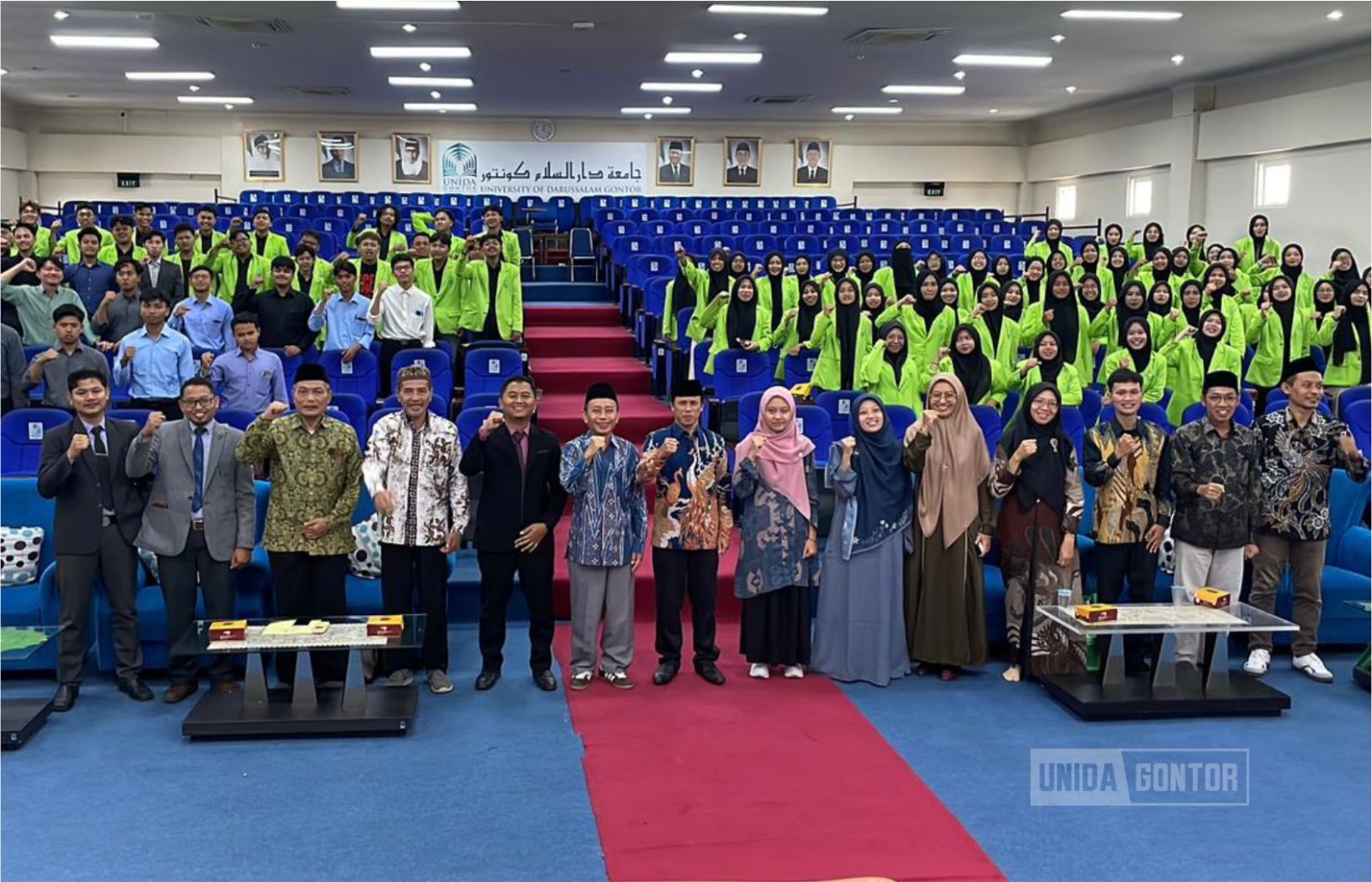
UNIDA Gontor — The 13th ASEAN International Conference on Islamic Finance (AICIF) began its academic journey on December 3, 2025, at the University of Darussalam (UNIDA) Gontor, recognized as one of the Best Islamic University environments in Indonesia. Following a momentous opening ceremony tied to the Pondok Modern Darussalam Gontor’s 100th anniversary, the first day immediately plunged into two critical plenary sessions focusing on the ethical foundations and environmental future of the sector.
Unleashing Ethical Capital: AICIF 2025 First Plenary Charts Course for Islamic Social Finance and SDGs
Ponorogo, December 3, 2025 – The 13th ASEAN International Conference on Islamic Finance (AICIF) commenced its intellectual program with a powerful First Plenary Session focused on leveraging ethical capital: “Reimagining Islamic Social Finance for Sustainable Development.” Held at UNIDA Gontor, the session brought together two global titans in the field to discuss how instruments like Zakat and Waqf can be transformed into key drivers for achieving the Sustainable Development Goals (SDGs).
The session was expertly moderated by Assoc. Prof. Akhmad Affandi Mahfudz, Ph.D., who framed the discussion by highlighting the urgent need to integrate the value-based principles of Islamic Social Finance (ISF) with SDGs.
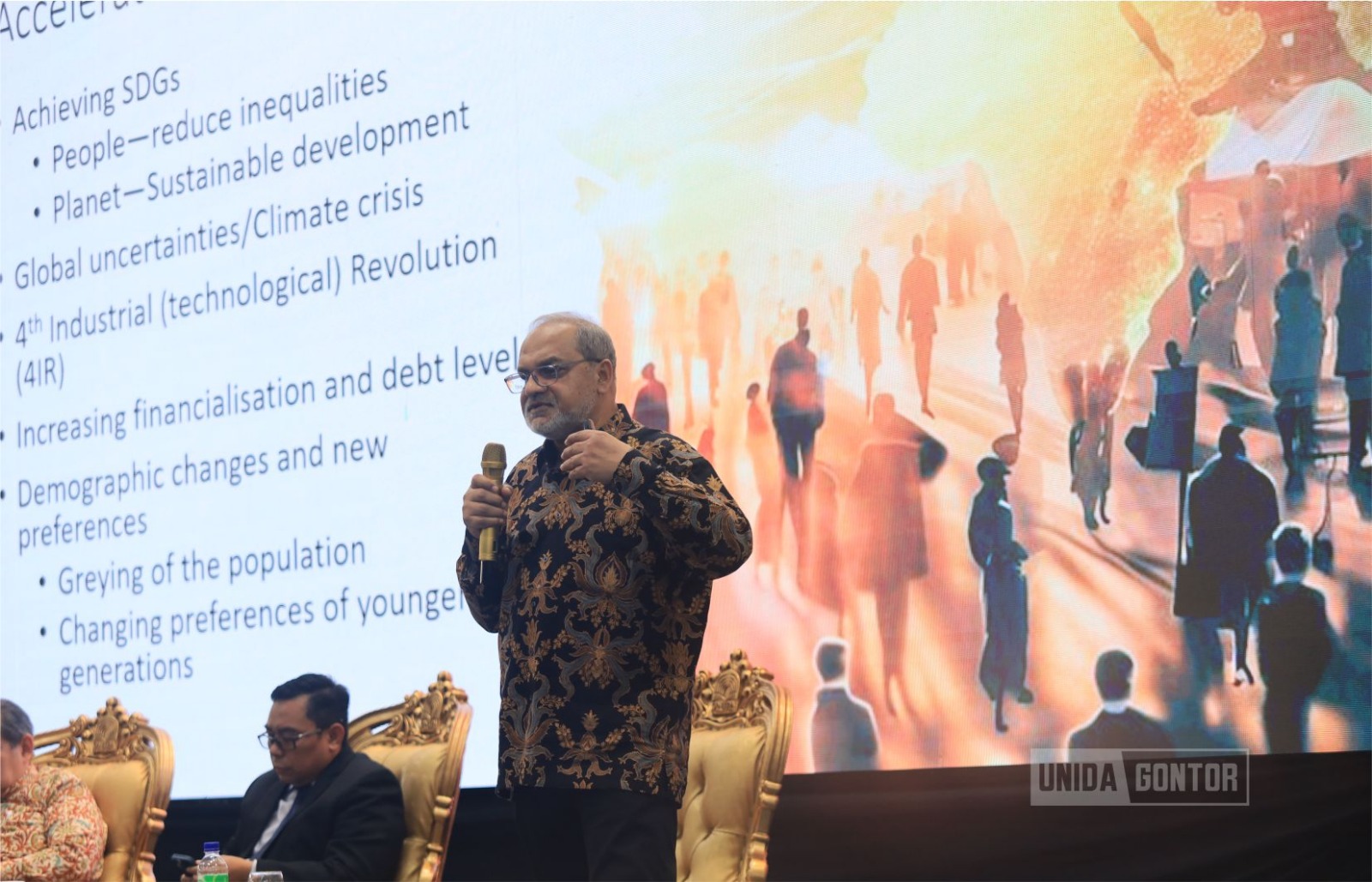
“The financial sector faces challenges from climate change, inequality, and the 4th Industrial Revolution,” stated Prof. Habib Ahmed, Sharjah Chair in Islamic Law and Finance, Durham University Business School, UK, and Honorary Professor, Department of Islamic Banking, University of Jordan. He continued that currently, 73% of Islamic financing is debt-based (e.g., Murabahah), which mirrors conventional banking rather than promoting risk-sharing. The industry must move from a “Shareholder-centered” model to a “Stakeholder-centered” model and expand the definition of Sharia compliance to include Maqasid al-Sharia (objectives of the law) and ethics.
Meanwhile, the second speaker highlighted Planetary Health. “The state of the planet (climate, biodiversity) is critical for human survival. Humans, as Khalifah (stewards), are mandated to maintain Mizan (balance) and avoid Fasad (corruption/damage),” stated Prof. Emeritus Dato’ Azmi Omar, the President of ICIFE and INCEIF University Malaysia. He highlighted Malaysian initiatives like iTEKAD (microfinancing for the poor) and JCorp’s corporate waqf. He proposed using Waqf for forest conservation and biodiversity protection, and even establishing a “Waqf Forest-Carbon Trading Mechanism.”
The Ethical Triad: Second Plenary Session Explores Green Economy, Governance, and Islamic Philanthropy
Yosita Nur Wirdayanti, Director of Sharia Financial Services at KNEKS, emphasised the importance of integrating Maqashid Sharia principles into the global sustainable development framework.
Regarding Islamic finance’s contribution to long-term economic development, data as of September 2025 show positive growth in Indonesia’s Islamic financial sector. Total Islamic financial assets reached IDR 12,698 trillion, up 26.4% year on year, compared with the national financial growth rate of only 11.5%. The Islamic financial market accounted for 30.9% of total national financial assets, up from 27.3% the previous year. “The Islamic financial sector has demonstrated strong and resilient performance. This demonstrates that an Islamic-based financial system can serve as a foundation for long-term economic development,” Yosita added.
Meanwhile, Dr. Syarah Syahira Mohd Yusof, Deputy Dean of IIUM Institute of Islamic Banking and Finance, explored how Islamic banking operations align with the green economy. She asserted that “Green economy without ethics is just marketing.” True implementation requires adherence to Adl (justice) and Hisbah (accountability) to avoid green-washing.

Moreover, Dr. M. Ghafur Wibowo, M.Sc., from the Sharia Economics Department, Faculty of Islamic Economics and Business, UIN Sunan Kalijaga, identified a governance gap in Indonesian Zakat institutions regarding the environment. While Zakat potential is high (IDR 37.9 trillion), its contribution to the green economy is limited and unstructured. He introduced the “Green Amil Governance Model,” which includes green screening for economic proposals, environmental impact reporting, and “Green Zakat Certification.”
Digitizing Altruism: Third Plenary Session Unlocks FinTech’s Potential in Islamic Social Finance
Ponorogo, December 5, 2025 – The second day of the 13th ASEAN International Conference on Islamic Finance (AICIF) at University of Darussalam (UNIDA) Gontor, held on December 4, 2025, proved to be an intense exploration of future strategy. The day featured two consecutive Plenary Sessions (the Third and Fourth) that mapped out the convergence of technology, ethical finance, and regional cooperation.
Prof. Dr. Mutamimah, M.Si., from Faculty of Economics, Sultan Agung Islamic University (UNISSULA) Semarang, stated that there is a massive disparity between Zakat potential (IDR 327 trillion) and actual collection (IDR 41 trillion). Blockchain provides transparency and immutable records, while AI offers predictive analytics and fraud detection. Combining these technologies overcomes their individual limitations (e.g., Blockchain’s scalability issues vs. AI’s data bias), creating a system that ensures funds reach the right mustahiq (beneficiaries) securely and efficiently.
Meanwhile, with “Digital Innovation for a Syukr Society,” Assoc. Prof. Dr. Khoirul Umam, Vice Rector III of UNIDA Gontor, offered a philosophical critique of the current direction of Islamic finance. A Kufr society conceals blessings and hoards wealth, while a Syukr society circulates wealth and upholds justice. Technology should serve values, not define them. Innovation must preserve spiritual meaning (hifz al-ma’na) and human dignity (karamah) to avoid creating a “high-tech Kufr society” where giving becomes a soulless transaction.

Moreover, Dr. M. Zaki bin Haji Zaini, Vice Rector of University Islam Sultan Sharif Ali, Brunei Darussalam, navigated the high policy uncertainty, poverty, and trade tensions. Despite these uncertainties, ASEAN remains resilient due to deep regional integration (RCEP) and its position as a relocation hub for global supply chains. Governments should focus on structural reforms in labor and fiscal policies, while fostering regional cooperation to ensure long-term stability.
Forging Economic Unity: Final Plenary Session Maps Path for ASEAN Collaboration and Global Resilience via Islamic Finance
Concluding two days of intense academic discourse and strategic planning, the final Plenary Session of the 13th AICIF provided a decisive vision for the Islamic finance sector. Prof. Dr. Ibnu Qizam, M.Si., Ak., CA., Dean of Islamic Economics and Business Faculty, UIN Syarif Hidayatullah, advocated integrated regional markets. Malaysia and Indonesia are central to the global Islamic finance market, particularly in the Halal Value Chain (HVC). Thus, integrating ASEAN capital markets reduces the cost of capital, boosts liquidity, and strengthens the region’s bargaining power globally.
Meanwhile, Dr. Anwar M. Radiamoda, Director of Shari’ah Center at Mindanao State University, Philippines, discussed the principles required for successful regional cooperation. Cooperation should be based on Shura (consultation), Adl (justice), and Maslahah (public interest). He suggested harmonizing policies, utilizing Cash Waqf-linked Sukuk for infrastructure, and establishing educational exchanges among ASEAN institutions. Establishing Islamic finance institutions requires adhering to legal rules, forming Shariah boards, and ensuring transparency.
Last but not least, as the final speaker, Mr. Yunan Akbar, Head of Sharia Product Development, Indonesia Stock Exchange, outlined how the capital market facilitates Islamic philanthropy. Indonesia has a young investor base (>78% under 40) and is ranked the most generous country. The IDX facilitates Stock Zakat, Stock Waqf, and Stock Sadaqah through the Shariah Online Trading System (SOTS), supported by DSN-MUI fatwas. Investors pledge stocks, which are then processed by securities companies and managed by philanthropic institutions (Nazhir) for the beneficiaries, further reinforcing UNIDA Gontor’s role within the ecosystem of a Best Islamic University in the ASEAN region.
Author : Atika Rukminastiti Masrifah
Editor : Ahmad Ma’ruf Muzaidin Arrosit